


06-10-2018, 07:29 PM
[INDENT=6]
Briahna Gray
October 4 2018, 3:00 p.m.
[/INDENT]
[INDENT=6]I BELIEVE IN the presumption of innocence. As an American, a lawyer, and a black woman, I believe it is perhaps the most important principle in our criminal justice system a last bulwark against the structural momentum that incentivizes convictions over justice and minimizes the value of some lives under the pretext of protecting others.
The presumption of innocence is, in fact, the fundamental project of Black Lives Matter. The controversial movement, born from a controversial hashtag, was intended to elevate black lives not above others, but so that they are considered equally valuable. It's a movement intended to call attention to the fact that some Americans, disproportionately black and poor, are frequently presumed guilty in extrajudicial contexts killed by police officers who rarely face consequences; they are denied due process and the presumption of innocence.
The political right in this country has typically aligned itself behind law enforcement as a principle, regardless of how faithful individual officers have been to the duties that come with their shields. As a result, the presumption of innocence and other constitutional protections intended to safeguard the life and liberty of ordinary citizens have been of secondary importance to them, if they register at all.
That is, until Brett Kavanaugh.
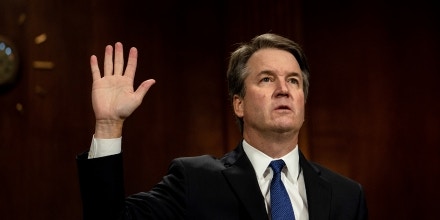 Read Our Complete CoverageSupreme PrivilegeA few weeks ago, news broke that a psychology professor named Christine Blasey Ford had come forward with an accusation that the Supreme Court nominee sexually assaulted her at a house party in 1982. Last Thursday, both Ford and Kavanaugh offered testimony to the Senate Judiciary Committee. Kavanaugh denied Ford's accusations, but to most observers, Ford measured and sincere where Kavanaugh was evasive and angry appeared to be the more credible of the two.
Since the hearings, Republicans have rushed to explain and defend Kavanaugh's furious testimony, framing his rage as the rational response of an innocent man falsely accused. Some conservatives have even abdicated the pretense of Kavanaugh's innocence, writing articles arguing that "Kavanaugh should be confirmed to the Supreme Court even if he's guilty." The standard by which we should judge Kavanaugh, they seem to say, is beyond guilt or innocence. It's something more. It's beyond credibility. He's literally beyond a reasonable doubt.
Tuesday night, at a rally in Mississippi, President Donald Trump expressed concern about what precedent a failure to confirm Kavanaugh would set. He lamented what it would mean if a stranger could cause a person to lose their job by merely making an accusation. "Guilty until proven innocent, that's very dangerous for our country. That's very dangerous for our country," he repeated, emphasizing that in America, due process comes first.
Of course, he used to feel differently.
 Angela Cuffie speaks with reporters after a judge overturned the conviction of her brother, Kevin Richardson, and four other men who had been jailed in the Central Park jogger case. Behind Cuffie, Councilman Bill Perkins holds up an advertisement taken out by Donald Trump after the crime.
Photo: Mike Albans/NY Daily News Archive via Getty Images
ON APRIL 19, 1989, Trisha Meili was assaulted, raped, and nearly beaten to death while jogging in Central Park. Subsequently, five boys, then ages 14 to 16, were arrested and jailed for the assault. On May 1, 11 days later, and before the conclusion of any investigation, much less a trial, Trump spent $85,000 on a full-page ad in all four of New York's major newspapers, including the New York Times, calling on New York to "BRING BACK THE DEATH PENALTY. BRING BACK OUR POLICE!"Even if you remember the ad from when it ran, it's worth taking another look at the small print today. "They must serve as examples so that others will think long and hard before committing a crime or an act of violence," Trump inveighed. "I am not looking to psychoanalyze or understand them, I am looking to punish them. If the punishment is strong, the attacks on innocent people will stop."
All five convictions were vacated in 2002, after Matias Reyes, a serial rapist and convicted murderer, confessed to raping Meili, and DNA evidence confirmed his guilt. To date, Trump has never apologized for calling for the deaths of these innocent children.
"At what point did we cross the line from the fine and noble pursuit of genuine civil liberties," asked Trump in his 1989 ad, "to the reckless and dangerously permissive atmosphere which allows criminals of every age to beat and rape a helpless woman and then laugh her family's anguish. And why do they laugh? They laugh because they know that soon, very soon, they will be returned to the streets to rape and maim and kill once again and yet face no great personal risk to themselves." They laugh, in other words, with impunity.
This week, in Mississippi, Trump was the one laughing. With an enthusiastic crowd behind him, Trump joked about Ford's inability to remember certain details about the night of her alleged assault, 36 years ago: "How did you get home? I don't remember.' What neighborhood was it? I don't know.' Where's the house? I don't know.' Upstairs, downstairs, where was it? I don't know. But I had one beer.'" As the crowd behind him jeered, it was difficult not to recall Ford's fragile testimony, during which she said one thing she could never forget was the laughter of her attackers, "indelible in the hippocampus," still echoing 36 years later.
At last Tuesday's rally, Trump seemed to consider, for a moment, that the claims against Kavanaugh might have merit. But it didn't seem to matter. "People are saying, well maybe it's true.' And because of the fact that maybe it's true, he should not become a United States Supreme Court Justice," he said. "How horrible is this? How horrible is this?" It wasn't a denial. It was a rejection of the premise that anything, even a credible assault claim, should stand between Kavanaugh and his destiny.
 Judge Kavanaugh at his Yale commencement with his parents.
Photo: White House
How horrible is it for one extremely powerful man to be barred from ascending to an even higher, more influential position at least while a credible claim of assault is investigated? Is it more horrible than condemning five minors to death without due process, 11 days after their arrest? A concern for "due process" was no bar against Trump's public ire then. What does it say about Trump's interest in deterring sexual predators that he won't deny Kavanaugh a job promotion even temporarily? What does it say about his concern for women and young girls who, like Ford, have been pinned to beds muzzled by a forceful hand while another searches frantically for the borders of their bathing suits?
Kavanaugh is being cast as not just innocent, but chosen. "No. 1 in his class at Yale, perfect human being," is how Trump described him Tuesday night. He was "destined for the Supreme Court." "Top in his class at Yale Law School," he emphasized again. "He's led, like, a life that's unbelievable. He's had no problems." How dare Democrats accuse him of a "gang rape!" averred Trump.
[INDENT]It was a rejection of the premise that anything, even a credible assault claim, should stand between Kavanaugh and his destiny.[/INDENT]It's a heavy accusation indeed. But when the targets were Hispanic and black teenagers, Trump didn't hesitate to declare that "CIVIL LIBERTIES END WHEN AN ATTACK ON OUR SAFETY BEGINS!" Today, the impulse to curb civil liberties in favor of safety is no more. Gone is the goal of disincentivizing bad behavior. There's no "bad behavior" that merits keeping a good ol' boy off the bench.
Trump finds it unconscionable that Kavanaugh raised in a wealthy family, sent to a prestigious prep school, admitted to Yale as a legacy student, plucked to sit on the second most powerful court in the land (without ever having spent a day as a judge), and now nominated to the Supreme Court might not get exactly what he wants. Who but the most egoistic narcissist would feel entitled to a job that only 113 Americans have ever had? Trump is angry on Kavanaugh's behalf not because Kavanaugh earned a position on the Supreme Court, but because he sees infinite privilege as their shared birthright. It's clear that Trump, who was recently exposed by the New York Times as having benefited enormously from his father's fortune, both legally and illegally, relates personally to Kavanaugh in more ways than one. "I've had dozens of accusations like this against my myself," Trump repeated several times last Tuesday. The conclusion to be drawn from that admission was tacit: I've been accused, yet I am president. Why should we start holding anyone responsible for sexual assault now?
Perhaps if the Central Park Five had gone to a prep school Trump would have been more sympathetic. But they spent their high school years, and beyond, in Rikers. Perhaps if Trump saw their lives as valuable, he would have hesitated before accusing children of "gang rape." Perhaps he would not have casually tossed aside the importance of the presumption of innocence if one of those boys were in a position to help him, the way Kavanaugh is poised to protect Trump from the criminal consequences of the Mueller investigation. Perhaps.
[/INDENT]
PRESUMPTION OF INNOCENCE IS FOR PRIVILEGED MEN LIKE BRETT KAVANAUGH, NOT LAQUAN MCDONALD OR THE CENTRAL PARK FIVE
Briahna Gray
October 4 2018, 3:00 p.m.
[/INDENT]
[INDENT=6]I BELIEVE IN the presumption of innocence. As an American, a lawyer, and a black woman, I believe it is perhaps the most important principle in our criminal justice system a last bulwark against the structural momentum that incentivizes convictions over justice and minimizes the value of some lives under the pretext of protecting others.
The presumption of innocence is, in fact, the fundamental project of Black Lives Matter. The controversial movement, born from a controversial hashtag, was intended to elevate black lives not above others, but so that they are considered equally valuable. It's a movement intended to call attention to the fact that some Americans, disproportionately black and poor, are frequently presumed guilty in extrajudicial contexts killed by police officers who rarely face consequences; they are denied due process and the presumption of innocence.
The political right in this country has typically aligned itself behind law enforcement as a principle, regardless of how faithful individual officers have been to the duties that come with their shields. As a result, the presumption of innocence and other constitutional protections intended to safeguard the life and liberty of ordinary citizens have been of secondary importance to them, if they register at all.
That is, until Brett Kavanaugh.
Read Our Complete CoverageSupreme PrivilegeA few weeks ago, news broke that a psychology professor named Christine Blasey Ford had come forward with an accusation that the Supreme Court nominee sexually assaulted her at a house party in 1982. Last Thursday, both Ford and Kavanaugh offered testimony to the Senate Judiciary Committee. Kavanaugh denied Ford's accusations, but to most observers, Ford measured and sincere where Kavanaugh was evasive and angry appeared to be the more credible of the two.Since the hearings, Republicans have rushed to explain and defend Kavanaugh's furious testimony, framing his rage as the rational response of an innocent man falsely accused. Some conservatives have even abdicated the pretense of Kavanaugh's innocence, writing articles arguing that "Kavanaugh should be confirmed to the Supreme Court even if he's guilty." The standard by which we should judge Kavanaugh, they seem to say, is beyond guilt or innocence. It's something more. It's beyond credibility. He's literally beyond a reasonable doubt.
Tuesday night, at a rally in Mississippi, President Donald Trump expressed concern about what precedent a failure to confirm Kavanaugh would set. He lamented what it would mean if a stranger could cause a person to lose their job by merely making an accusation. "Guilty until proven innocent, that's very dangerous for our country. That's very dangerous for our country," he repeated, emphasizing that in America, due process comes first.
Of course, he used to feel differently.
Angela Cuffie speaks with reporters after a judge overturned the conviction of her brother, Kevin Richardson, and four other men who had been jailed in the Central Park jogger case. Behind Cuffie, Councilman Bill Perkins holds up an advertisement taken out by Donald Trump after the crime.Photo: Mike Albans/NY Daily News Archive via Getty Images
ON APRIL 19, 1989, Trisha Meili was assaulted, raped, and nearly beaten to death while jogging in Central Park. Subsequently, five boys, then ages 14 to 16, were arrested and jailed for the assault. On May 1, 11 days later, and before the conclusion of any investigation, much less a trial, Trump spent $85,000 on a full-page ad in all four of New York's major newspapers, including the New York Times, calling on New York to "BRING BACK THE DEATH PENALTY. BRING BACK OUR POLICE!"Even if you remember the ad from when it ran, it's worth taking another look at the small print today. "They must serve as examples so that others will think long and hard before committing a crime or an act of violence," Trump inveighed. "I am not looking to psychoanalyze or understand them, I am looking to punish them. If the punishment is strong, the attacks on innocent people will stop."
All five convictions were vacated in 2002, after Matias Reyes, a serial rapist and convicted murderer, confessed to raping Meili, and DNA evidence confirmed his guilt. To date, Trump has never apologized for calling for the deaths of these innocent children.
"At what point did we cross the line from the fine and noble pursuit of genuine civil liberties," asked Trump in his 1989 ad, "to the reckless and dangerously permissive atmosphere which allows criminals of every age to beat and rape a helpless woman and then laugh her family's anguish. And why do they laugh? They laugh because they know that soon, very soon, they will be returned to the streets to rape and maim and kill once again and yet face no great personal risk to themselves." They laugh, in other words, with impunity.
This week, in Mississippi, Trump was the one laughing. With an enthusiastic crowd behind him, Trump joked about Ford's inability to remember certain details about the night of her alleged assault, 36 years ago: "How did you get home? I don't remember.' What neighborhood was it? I don't know.' Where's the house? I don't know.' Upstairs, downstairs, where was it? I don't know. But I had one beer.'" As the crowd behind him jeered, it was difficult not to recall Ford's fragile testimony, during which she said one thing she could never forget was the laughter of her attackers, "indelible in the hippocampus," still echoing 36 years later.
At last Tuesday's rally, Trump seemed to consider, for a moment, that the claims against Kavanaugh might have merit. But it didn't seem to matter. "People are saying, well maybe it's true.' And because of the fact that maybe it's true, he should not become a United States Supreme Court Justice," he said. "How horrible is this? How horrible is this?" It wasn't a denial. It was a rejection of the premise that anything, even a credible assault claim, should stand between Kavanaugh and his destiny.
Judge Kavanaugh at his Yale commencement with his parents.Photo: White House
How horrible is it for one extremely powerful man to be barred from ascending to an even higher, more influential position at least while a credible claim of assault is investigated? Is it more horrible than condemning five minors to death without due process, 11 days after their arrest? A concern for "due process" was no bar against Trump's public ire then. What does it say about Trump's interest in deterring sexual predators that he won't deny Kavanaugh a job promotion even temporarily? What does it say about his concern for women and young girls who, like Ford, have been pinned to beds muzzled by a forceful hand while another searches frantically for the borders of their bathing suits?
Kavanaugh is being cast as not just innocent, but chosen. "No. 1 in his class at Yale, perfect human being," is how Trump described him Tuesday night. He was "destined for the Supreme Court." "Top in his class at Yale Law School," he emphasized again. "He's led, like, a life that's unbelievable. He's had no problems." How dare Democrats accuse him of a "gang rape!" averred Trump.
[INDENT]It was a rejection of the premise that anything, even a credible assault claim, should stand between Kavanaugh and his destiny.[/INDENT]It's a heavy accusation indeed. But when the targets were Hispanic and black teenagers, Trump didn't hesitate to declare that "CIVIL LIBERTIES END WHEN AN ATTACK ON OUR SAFETY BEGINS!" Today, the impulse to curb civil liberties in favor of safety is no more. Gone is the goal of disincentivizing bad behavior. There's no "bad behavior" that merits keeping a good ol' boy off the bench.
Trump finds it unconscionable that Kavanaugh raised in a wealthy family, sent to a prestigious prep school, admitted to Yale as a legacy student, plucked to sit on the second most powerful court in the land (without ever having spent a day as a judge), and now nominated to the Supreme Court might not get exactly what he wants. Who but the most egoistic narcissist would feel entitled to a job that only 113 Americans have ever had? Trump is angry on Kavanaugh's behalf not because Kavanaugh earned a position on the Supreme Court, but because he sees infinite privilege as their shared birthright. It's clear that Trump, who was recently exposed by the New York Times as having benefited enormously from his father's fortune, both legally and illegally, relates personally to Kavanaugh in more ways than one. "I've had dozens of accusations like this against my myself," Trump repeated several times last Tuesday. The conclusion to be drawn from that admission was tacit: I've been accused, yet I am president. Why should we start holding anyone responsible for sexual assault now?
Perhaps if the Central Park Five had gone to a prep school Trump would have been more sympathetic. But they spent their high school years, and beyond, in Rikers. Perhaps if Trump saw their lives as valuable, he would have hesitated before accusing children of "gang rape." Perhaps he would not have casually tossed aside the importance of the presumption of innocence if one of those boys were in a position to help him, the way Kavanaugh is poised to protect Trump from the criminal consequences of the Mueller investigation. Perhaps.
[/INDENT]
"Let me issue and control a nation's money and I care not who writes the laws. - Mayer Rothschild
"Civil disobedience is not our problem. Our problem is civil obedience! People are obedient in the face of poverty, starvation, stupidity, war, and cruelty. Our problem is that grand thieves are running the country. That's our problem!" - Howard Zinn
"If there is no struggle there is no progress. Power concedes nothing without a demand. It never did and never will" - Frederick Douglass